Buying acreage in Bonneville County can feel like a dream come true until you realize that not all land works the same way. A parcel that looks perfect in photos may come with limits on building, access, water, or future use. If you are hoping to buy land with confidence, it helps to understand what really drives value and usability before you close. Let’s dive in.
Start With Zoning First
If you are buying acreage in Bonneville County, zoning should be one of the first things you review. County code includes several rural-focused districts, but A-1 Agricultural, RA-1 Residential Agricultural, and G-1 Grazing are some of the most important for acreage buyers to understand.
In the A-1 Agricultural zone, agricultural and livestock uses, poultry production, and other agricultural activities are allowed. Dwellings may also be permitted, but density rules become more restrictive as parcels are farther from incorporated cities or urban growth areas. The county also requires site-plan review for A-1 dwellings, including impacts on roads, utilities, irrigation, and irrigation delivery systems.
RA-1 Residential Agricultural is more residential in character. County code states that residential use has primacy in this zone, while animals and fowl are generally allowed for family food and personal enjoyment. That matters if you want some flexibility for country living but are not necessarily looking for a full agricultural setup.
The G-1 Grazing zone is intended for large tracts used for grazing and dry farming. Its purpose includes supporting livestock and dry-farming operations, conserving natural resources, and reducing flood, fire, and public-service concerns in sparsely populated areas. If you are looking at more remote land, this zone may fit the parcel, but it can signal a very different use pattern than residential acreage closer to growth areas.
Why Zoning Shapes Your Long-Term Plans
Zoning is not just about what you can do on day one. It also affects what the property may support over time, whether that means building a home, keeping animals, adding structures, or exploring a future split.
In Bonneville County, land near incorporated areas or growth areas may have a different long-term profile than more remote acreage. County rules already treat some parcels differently based on location, and University of Idaho reports that factors like population growth and irrigation infrastructure can influence Idaho farmland values. In simple terms, where the acreage sits can matter almost as much as how many acres you buy.
Utilities Matter More Than Acre Count
One of the biggest surprises for acreage buyers is that raw acreage does not automatically equal buildability. Two parcels with the same size can have very different costs, timelines, and limitations depending on water, septic, and utility readiness.
If a parcel needs a new well, Idaho law requires a drilling permit from the Idaho Department of Water Resources before drilling begins. The well must also be built by a licensed Idaho well driller. For domestic wells, IDWR says additional approvals are not required before the drilling permit is approved, but irrigation, commercial, industrial, multi-family, and municipal wells require approved water rights before approvals are issued.
For septic, Eastern Idaho Public Health handles permits through the local public health district, and the Idaho Department of Environmental Quality says a site evaluation should be completed before you buy property and apply for a permit. Septic design depends on soil type, slope, and proximity to water bodies. That is why one acreage lot may be much easier to build on than another, even when they look similar at first glance.
Bonneville County also notes that starting January 20, 2026, it is processing electrical and plumbing permits and handling related inspections. If you plan to build later, county permitting belongs on your due-diligence list early in the process.
Agricultural Land Still Has Rules
Acreage buyers sometimes assume that rural land comes with fewer restrictions across the board. In practice, county code often creates a different set of rules, not a rule-free environment.
Bonneville County says agricultural structures on parcels of five acres or more may qualify for a building-code exception, but the structure still needs a zoning permit and must meet setback requirements. So if you are planning a shop, barn, or other agricultural building, you will still want to confirm what approvals apply.
Livestock facilities also have setback standards. The county says barns, corrals, pens, coops, and similar enclosures cannot be closer than 100 feet from an adjacent dwelling, church, school, or similar occupied building, and cannot be closer than 50 feet from the property line. Pastures and year-round vegetated enclosures are treated differently, which makes it important to review the exact use you have in mind.
Access Can Make or Break Acreage Living
A beautiful parcel is much easier to enjoy when you can reliably get to it in every season. In Bonneville County, road access and maintenance deserve close attention before you close.
The county’s snow-removal policy prioritizes high-volume arterial roads first, then collector roads, then low-volume local roads such as subdivision roads and secondary roads. The county also states clearly that it will not remove snow from private roads and driveways. If year-round access matters to you, this is one of the first questions to answer.
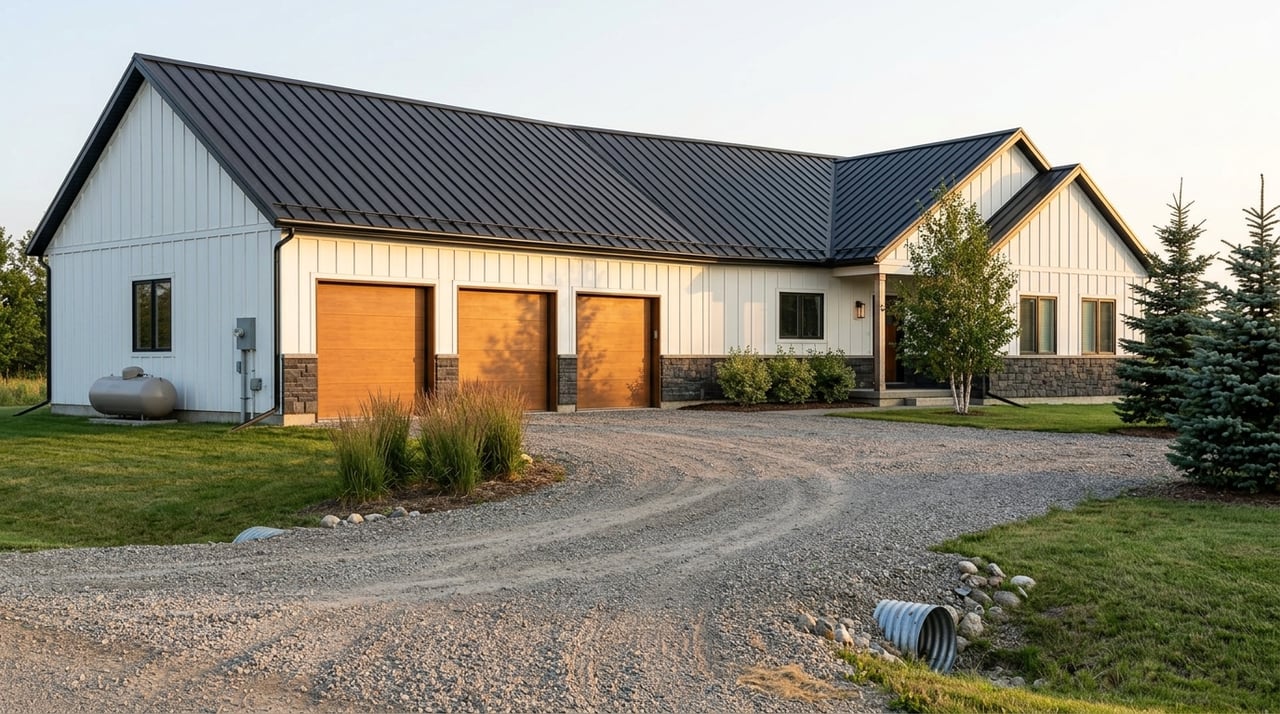
Driveway responsibility is another detail that can affect both cost and convenience. Bonneville County says property owners are responsible for driveway approaches, and if a driveway crosses a drainage swale, a culvert is required under the approach. That means a rural driveway may involve more maintenance and expense than buyers expect.
The county also warns that encroachments in the public right-of-way can create safety issues, and it does not take responsibility for landscape or mailbox damage near the road. On acreage, understanding where the right-of-way ends can help you see how much truly usable yard or frontage you have.
If the parcel sits on a gravel road, dust control is not automatic. Bonneville County says dust-control costs are assigned to the property owners requesting it. That makes road quality and maintenance a parcel-specific issue, not something to assume based on the listing alone.
Easements and Surveys Need Careful Review
Access is not always as simple as seeing a road on a map. Easements, legal descriptions, and recorded documents can affect how you reach the property and what rights come with it.
Bonneville County’s Assessor says it does not currently track or map easements. The county also notes that a recorded survey does not change property boundaries or parcel numbers on its own, because a deed with the new legal description is required. For acreage buyers, that makes title work, a survey, and document review especially important.
This is also relevant if you are buying land with the hope of creating a cleaner future boundary, confirming legal access, or clarifying where improvements can go. A parcel that seems straightforward in person may still need careful legal review to confirm how it functions on paper.
Future Subdivision Is Never a Safe Assumption
If part of your plan is to split the property later, verify that possibility before you buy. In Bonneville County, land cannot be subdivided without county approval.
County rules also state that resubdividing an existing plat is limited unless the new lots are at least as large as the smallest lot in the original division, unless a rezone applies. In other words, future flexibility may depend on zoning, plat history, and county approvals, not just acreage size.
Subdivision design standards matter, too. Bonneville County says every lot in a subdivision must abut an approved street except in forest-recreation zones, and direct access from a subdivision lot to an arterial road is prohibited. That can affect both future planning and resale strategy.
Water and Irrigation Deserve Extra Attention
Water can be one of the most important value drivers on acreage. University of Idaho notes that small-acreage properties can have unique water-access issues, especially when they are subdivisions of larger properties.
Before you buy, it is wise to understand water rights, water shares, irrigation rules, and the amount, timing, and season of water access. A parcel with usable irrigation and a clear understanding of delivery systems may be easier to use and easier to improve than land with unanswered water questions.
Bonneville County’s zoning code reinforces this point. In A-1, site-plan review specifically looks at irrigation and irrigation delivery systems, while the G-1 zone is intended in part to conserve water and related natural resources. For buyers, that means water is not a side issue. It is central to how the land works.
Drainage and Site Conditions Affect Value
Not every attractive parcel is equally practical. Topography, drainage, and site conditions can all affect what you can build, how much it may cost, and whether the land is suitable for future division.
University of Idaho advises small-acreage buyers to evaluate natural resources, topography, climate, pests and problems, physical assets, nearby activity, site history, and legal or regulatory considerations. This is a good reminder that the lowest-priced parcel is not always the strongest value.
Bonneville County’s design standards also say land found unsuitable for subdivision because of flooding, bad drainage, steep slopes, rock formations, or other harmful features should not be subdivided unless approved methods will overcome the problem. If a parcel has drainage or terrain issues, those conditions can affect both your immediate plans and future options.
A Simple Acreage Due-Diligence Checklist
Before you move forward on acreage in Bonneville County, make sure you confirm the basics that shape daily use and long-term value.
- Verify the zoning district and what uses are allowed
- Confirm whether a home site is permitted and what review process applies
- Ask about well feasibility and any needed permits
- Check septic site-evaluation requirements before purchase
- Review utility availability and future permit needs
- Confirm road type, winter maintenance, and driveway responsibilities
- Look closely at easements, legal access, and recorded documents
- Ask whether subdivision or future parcel splits are possible
- Understand irrigation access, delivery systems, and water timing
- Evaluate drainage, slopes, and other site limitations
The Bottom Line for Acreage Buyers
Buying acreage in Bonneville County can open the door to space, flexibility, and a different kind of lifestyle. At the same time, the smartest acreage purchases usually come down to the details behind the listing, especially zoning, water, septic, access, and future use.
When you understand how the parcel works before you buy, you can make a clearer decision and avoid costly surprises later. If you are weighing acreage in Bonneville County and want local guidance with a calm, thoughtful approach, connect with Abigail Martin for help evaluating the details that matter most.
FAQs
What should I check first before buying acreage in Bonneville County?
- Start with zoning, legal access, water, septic feasibility, utilities, and road maintenance so you know whether the land supports your plans.
Can I keep animals on acreage in Bonneville County?
- It depends on the zoning district. RA-1 has animal-count limits tied to lot size, while A-1 is more agricultural in character but still has setback and health standards.
Will Bonneville County plow the road to my acreage property?
- The county plows public county roads based on its snow-removal priorities, but it does not remove snow from private roads or driveways.
Can I build on acreage in Bonneville County without city water and sewer?
- Possibly, but you need to verify well feasibility, septic approval, utility availability, access, setbacks, and permit requirements before assuming the parcel is buildable.
Can I split acreage later in Bonneville County?
- Not automatically. Subdivision or resubdivision requires county approval, and zoning and plat history can affect what is possible.
Why is water so important when buying acreage in Bonneville County?
- Water access can affect how you use the land, whether irrigation is available, and how practical the parcel is for future improvements or long-term ownership.